Erode

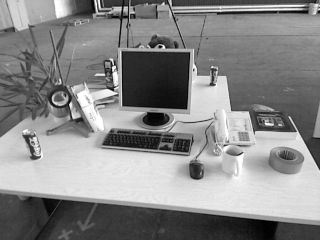
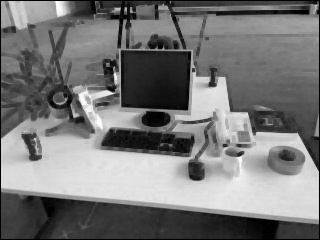
The erosion (corrosion) algorithm performs a 2D filtering operation on the input image using the provided 2D Boolean kernel. The Boolean kernel size defines the pixel neighborhood of the filtering operation. As a morphological operation operator, equivalent to a minimization operation, it reduces or shrinks the foreground area in the picture (in this case the white color in the figure below), the causes unwanted small or thin objects to disappear, recognizing and filling holes in the picture.

Operator Effect

Input ImageParameterOutput Image
image-image

Principle

dst(x,y)=min0i<ksize0j<ksizesrc(xksize12+i,yksize12+j)\begin{aligned}dst(x,y)=\min_{\begin{aligned} 0 \leqslant i<ksize \\ 0 \leqslant j < ksize\end{aligned}} src(x-\lfloor\frac{ksize-1}{2}\rfloor+i,y-\lfloor\frac{ksize-1}{2}\rfloor+j)\end{aligned}

The erosion filter is equivalent to the minimum operation and will shrink the bright structures in the image, another morphological filter is Dilate, which is equivalent to the maximum operation. Expansion filters may be used after erosion filters to form morphological closures of the image.

API Interface

int32_t hbVPErode(hbUCPTaskHandle_t *taskHandle,
                  hbVPImage *dstImg,
                  hbVPImage const *srcImg,
                  hbVPFilterKernel const *erodeKernel,
                  hbVPErodeParam const *erodeParam);

For detailed interface information, please refer to hbVPErode.

Usage

// Include the header
#include "hobot/hb_ucp.h"
#include "hobot/vp/hb_vp.h"
#include "hobot/vp/hb_vp_erode.h"

// init Image, allocate memory for image data
hbUCPSysMem src_mem;
hbUCPMallocCached(&src_mem, src_stride * src_height, 0);
hbVPImage src_img{HB_VP_IMAGE_FORMAT_Y,
                  HB_VP_IMAGE_TYPE_U8C1,
                  src_width,
                  src_height,
                  src_stride,
                  src_mem.virAddr,
                  src_mem.phyAddr,
                  nullptr,
                  0,
                  0};

hbUCPSysMem dst_mem;
hbUCPMallocCached(&dst_mem, dst_stride * dst_height, 0);
hbVPImage dst_img{HB_VP_IMAGE_FORMAT_Y,
                  HB_VP_IMAGE_TYPE_U8C1,
                  dst_width,
                  dst_height,
                  dst_stride,
                  dst_mem.virAddr,
                  dst_mem.phyAddr,
                  nullptr,
                  0,
                  0};

// init kernel
hbVPFilterKernel kernel;
kernel.dataType = HB_VP_IMAGE_TYPE_U8C1;
kernel.width = 3;
kernel.height = 3;
hbUCPSysMem kernel_mem;
hbUCPMallocCached(&kernel_mem, kernel.width * kernel.height, 0);
kernel.dataPhyAddr = kernel_mem.phyAddr;
kernel.dataVirAddr = kernel_mem.virAddr;

// init param
hbVPErodeParam erode_param;
erode_param.pointLocX = -1;
erode_param.pointLocY = -1;
erode_param.iterations = 1;
erode_param.borderType = HB_VP_BORDER_CONSTANT;
erode_param.borderValue = 0;

// init task handle and schedule param
hbUCPTaskHandle_t task_handle{nullptr};
hbUCPSchedParam sched_param;
HB_UCP_INITIALIZE_SCHED_PARAM(&sched_param);
sched_param.backend = HB_UCP_DSP_CORE_0;

// create task
hbVPErode(&task_handle, &dst_img, &src_img, &kernel, &erode_param);

// submit task
hbUCPSubmitTask(task_handle, &sched_param);

// wait for task done 
hbUCPWaitTaskDone(task_handle, 0);

// release task handle
hbUCPReleaseTask(task_handle);

// release memory
hbUCPFree(&src_mem);
hbUCPFree(&dst_mem);
hbUCPFree(&kernel_mem);